
The generative AI revolution is no longer a speculative technological trend; it is a fundamental, trillion-dollar infrastructure shift reshaping global industries. At the epicenter of this transformation stands Anthropic, a company rapidly transitioning from an ambitious startup to a computational behemoth. The news that Anthropic has secured a massive 3.5 GW AI compute deal, backed by industry giants Google and Broadcom, is not merely a funding announcement—it is a declaration of market dominance. This monumental deal, coupled with the company’s trajectory toward a staggering $30 billion revenue milestone, signals a new era of AI capability, defining the next generation of large language models (LLMs) and enterprise AI deployment.
This deep dive explores what this deal truly means for the AI landscape, examining the technical requirements of 3.5 GW of compute, the strategic synergy between Anthropic, Google, and Broadcom, and the profound market implications that will redefine how businesses interact with artificial intelligence.
The Compute Imperative: Why 3.5 GW is a Game Changer
To understand the significance of 3.5 Gigawatts (GW), one must first grasp the sheer scale of modern AI training. Training state-of-the-art LLMs like Claude requires astronomical amounts of processing power, consuming energy and hardware resources that rival national infrastructure projects.
A 3.5 GW commitment is not just a large number; it represents a sustained, multi-petascale processing capability. For context, a typical hyperscale data center might operate at a fraction of this capacity. This massive power allocation means Anthropic is not just upgrading its current capabilities; it is building an entirely new, self-sustaining computational pillar.
This scale addresses the core bottleneck of the current AI boom: compute. While model architecture and algorithmic efficiency are crucial, the physical ability to train, fine-tune, and run these models at unprecedented speeds is the ultimate limiting factor. The 3.5 GW deal ensures that Anthropic can maintain a continuous, high-velocity development cycle, allowing them to iterate on models that are larger, more complex, and more capable than anything currently available.
This compute power translates directly into model capability. It allows for:
- Deeper Training: Running models on more data points for longer periods, improving factual accuracy and reasoning.
- Multimodality Mastery: Training models that seamlessly integrate text, images, audio, and video inputs, moving beyond simple text generation.
- Safety and Alignment: Running extensive red-teaming and alignment protocols, which are computationally intensive, ensuring the models are safe for enterprise use.
The sheer energy commitment underscores Anthropic’s ambition to lead the frontier, making them a critical infrastructure provider for the global digital economy.
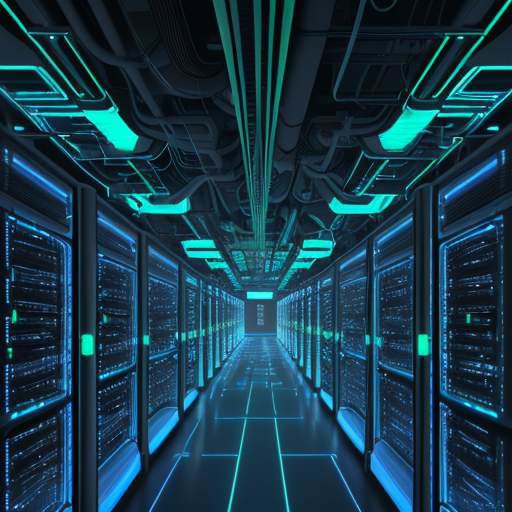
[IMAGE PROMPT: A dramatic, futuristic data center interior viewed from a high angle, showing massive rows of supercomputers glowing with cool blue and green lights. Cables are thick and complex, suggesting immense power flow. The atmosphere is highly technical and futuristic, conveying immense computational power. The scene should look clean, organized, and overwhelmingly powerful, emphasizing the scale of the 3.5 GW capacity. photorealistic, high quality, cinematic lighting, sharp details, 16:9 aspect ratio, final image width 650px strict, no text in image, no watermark, optimized for Flux/SD3/SDXL]
The Strategic Partnership: Google and Broadcom Synergy
The involvement of Google and Broadcom is arguably as significant as the compute deal itself. These two companies bring complementary, best-in-class expertise that mitigates risk and maximizes efficiency for Anthropic. This is not merely a vendor relationship; it is a strategic trifecta designed for AI supremacy.
Google’s Role: The Ecosystem and Data Backbone
Google provides more than just compute access; it offers a deep, integrated ecosystem. This includes access to vast datasets, advanced cloud infrastructure (Google Cloud Platform), and pioneering research in AI hardware and optimization. Google’s expertise in search, information retrieval, and global data management ensures that Anthropic’s models are trained not only on volume but on unparalleled quality and diversity of information. This partnership allows Anthropic to embed its models into the world’s most complex information flows.
Broadcom’s Role: The Hardware Engine
Broadcom is a global leader in semiconductor solutions, particularly high-speed networking and specialized AI accelerators. In the world of massive compute, the bottleneck often shifts from raw processing power (the GPU) to the speed of communication between those processors. Broadcom’s expertise in custom silicon, high-bandwidth memory, and networking chips is crucial. They ensure that the 3.5 GW of compute is not just there, but that it can communicate with near-zero latency, maximizing the efficiency and throughput of every single transistor.
The Synergy:
The combined power is transformative. Google provides the data and the cloud reach; Broadcom provides the hyper-efficient plumbing and specialized chips; and Anthropic provides the cutting-edge, safety-focused model architecture (Claude). This eliminates single points of failure and creates a vertically integrated, highly resilient AI super-system.
[IMAGE PROMPT: A conceptual, stylized graphic showing three interconnected, glowing nodes labeled ‘Anthropic,’ ‘Google,’ and ‘Broadcom.’ The nodes are linked by glowing, complex energy pathways, symbolizing data flow and computational power. The background should be dark and futuristic, emphasizing the synergy and partnership. The visual should convey massive, controlled energy transfer and collaborative intelligence. photorealistic, high quality, cinematic lighting, sharp details, 16:9 aspect ratio, final image width 650px strict, no text in image, no watermark, optimized for Flux/SD3/SDXL]
Technical Deep Dive: Scaling LLMs and Infrastructure
Achieving 3.5 GW of reliable, high-speed compute requires solving some of the most complex engineering problems in modern physics and computer science. This isn’t just about buying more chips; it’s about revolutionizing the entire physical data center stack.
The Cooling Challenge:
The density of modern AI chips generates enormous amounts of heat. Traditional air cooling is insufficient for this level of power. The infrastructure must incorporate advanced liquid cooling solutions—often direct-to-chip liquid cooling—to maintain optimal operational temperatures and prevent thermal throttling. The sheer scale of the cooling system needed for 3.5 GW is a monumental feat of civil and mechanical engineering, placing Anthropic at the forefront of sustainable, high-density computing design.
Networking and Interconnects:
The most advanced LLMs are inherently distributed, meaning they cannot run on a single chip. They require thousands of chips working in concert. The speed at which these chips exchange parameters and gradients (the training signals) is paramount. This necessitates the use of cutting-edge interconnect technologies, such as those optimized by Broadcom, allowing petabytes of data to move across the system instantaneously. The efficiency of the network fabric determines the effective size of the model and the speed of training.
Algorithmic Efficiency:
While hardware is critical, the partnership also implies a focus on algorithmic efficiency. Anthropic’s research teams will work with Google and Broadcom to optimize model architectures specifically for the available hardware. This might involve exploring Mixture-of-Experts (MoE) models, which allow the model to activate only the necessary parts of its parameters for a given query, drastically reducing computational load without sacrificing intelligence.
[IMAGE PROMPT: A detailed cross-section view of a futuristic, highly efficient data center rack. Focus on the advanced liquid cooling pipes running directly to the server chips, visible through clear panels. The chips themselves should be glowing with internal blue light, indicating massive processing power. The overall aesthetic must be hyper-technical and clean, emphasizing thermal management and density. photorealistic, high quality, cinematic lighting, sharp details, 16:9 aspect ratio, final image width 650px strict, no text in image, no watermark, optimized for Flux/SD3/SDXL]
Market Implications and the $30 Billion Trajectory
The computational power secured by Anthropic is the engine driving its financial narrative. The $30 billion revenue milestone is not just a financial marker; it is a validation of the market’s willingness to pay a premium for safety, capability, and reliability in AI.
Redefining Enterprise AI:
The market is moving past generalized, consumer-facing AI. The next wave of revenue will come from highly specialized, regulated, and mission-critical enterprise applications. Anthropic’s focus on safety and constitutional AI makes it a preferred partner for industries like finance, healthcare, and defense, where model failure carries massive liability. The 3.5 GW compute power ensures they can meet the rigorous, high-volume demands of these sectors.
The Competitive Landscape:
This move solidifies Anthropic’s position as a top-tier competitor to OpenAI and Google’s internal AI efforts. By securing such deep, multi-vendor compute resources, Anthropic is effectively creating a moat around its operations. Competitors must now contend with a resource advantage that is difficult and expensive to replicate. This focus on infrastructure superiority allows Anthropic to dedicate its resources entirely to model quality and safety, rather than struggling with compute access.
The Economic Feedback Loop:
The relationship between compute and revenue is cyclical. Massive compute capacity \(\rightarrow\) Superior Model Performance \(\rightarrow\) Increased Enterprise Adoption \(\rightarrow\) Exponential Revenue Growth. The 3.5 GW deal fuels this positive feedback loop, positioning Anthropic for hyper-growth and solidifying its status as an AI infrastructure leader.
[IMAGE PROMPT: A conceptual, abstract visualization of data flowing rapidly through a global network grid overlaid on a stylized map of major global financial hubs (New York, London, Tokyo). The data streams are glowing blue and gold, representing massive capital flow and AI integration. The image should convey interconnectedness, global reach, and the sheer scale of the economic impact of advanced AI. photorealistic, high quality, cinematic lighting, sharp details, 16:9 aspect ratio, final image width 650px strict, no text in image, no watermark, optimized for Flux/SD3/SDXL]
Conclusion: Defining the Next Decade of Intelligence
Anthropic’s 3.5 GW compute deal with Google and Broadcom is far more than a technical transaction; it is a definitive statement about the future architecture of intelligence. It confirms that the era of AI development is transitioning from an academic pursuit to a critical, highly capitalized, and intensely engineered industrial undertaking.
By securing this immense computational backbone, Anthropic is guaranteeing its ability to lead the development of models that are not only powerful but also demonstrably safe, reliable, and adaptable for the world’s most demanding industries. The convergence of unparalleled compute power, deep industry partnerships, and a clear focus on enterprise safety positions Anthropic perfectly to realize its $30 billion potential and define the next decade of artificial intelligence.
For businesses, this means a future where AI is not a novelty, but a deeply integrated, reliable, and scalable operational utility—powered by the infrastructure giants and guided by the safety-first principles of Anthropic. The race for AI supremacy has just entered a new, profoundly powerful gear.