The Artificial Intelligence revolution has been hailed as the most transformative technological shift since the internet. From generative AI models powering creative industries to complex predictive analytics driving scientific discovery, AI is no longer a futuristic concept—it is the foundational utility of the modern digital economy. Yet, beneath the veneer of dazzling AI capabilities lies a rapidly escalating, often invisible bottleneck: the sheer cost and energy consumption of running these models.
Currently, the power to build and deploy sophisticated AI models is constrained by two primary factors: computational power and, critically, the operational expenditure (OpEx) associated with running those models—a process known as AI inference. Every time ChatGPT answers a question, every time an image generator creates a piece of art, or every time a self-driving car processes sensor data, an inference occurs. And these inferences are expensive.
This is where the pioneering work emerging from UK startups, particularly those focused on advanced memory architectures like Static Random-Access Memory (SRAM), enters the spotlight. The promise is nothing short of revolutionary: the potential to slash AI inference costs by a factor of ten or more. This isn’t just an incremental improvement; it represents a fundamental shift in how AI hardware is designed, moving us closer to truly scalable, democratized, and sustainable AI infrastructure.
The Inference Bottleneck: Why Running AI is So Expensive
To understand the magnitude of the SRAM breakthrough, one must first grasp the core problem: the inference bottleneck.
AI models, especially Large Language Models (LLMs), are massive mathematical constructs. They consist of billions, sometimes trillions, of parameters—weights that must be multiplied by incoming data (the prompt or input). This process requires immense computational cycles.
Traditional AI inference relies heavily on specialized hardware, primarily Graphics Processing Units (GPUs) and Tensor Processing Units (TPUs). These chips are phenomenal at parallel processing, making them ideal for the matrix multiplications inherent in deep learning. However, their efficiency is limited by the memory subsystem.
When an LLM runs, the data (the weights and the intermediate calculations) must constantly be moved between the main memory (like High Bandwidth Memory, HBM) and the processing cores. Data movement—the act of shuttling bits from one physical location to another—is notoriously energy-intensive and time-consuming. This phenomenon is often referred to as the "memory wall."
The more complex the model, the more data must be moved, and the more expensive and power-hungry the operation becomes. This high operational cost limits the deployment of advanced AI to a handful of well-funded tech giants, creating a barrier to entry that stifles innovation globally.
SRAM: The Game Changer in Memory Architecture
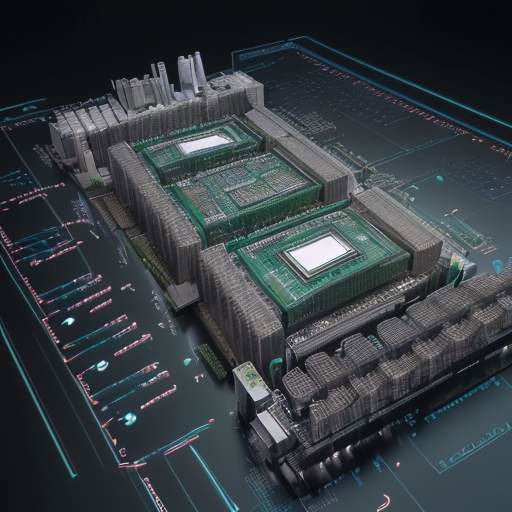
Static Random-Access Memory (SRAM) is a type of volatile semiconductor memory. While DRAM (Dynamic Random-Access Memory) is the workhorse of general computing, SRAM has long been known for its speed and stability. It is the memory technology used for CPU caches—the small, ultra-fast memory located directly on the processor die.
The genius of the SRAM-based solution for AI inference lies in its ability to dramatically reduce the distance and energy required for data access.
In a conventional system, the weights of a massive AI model are stored in off-chip memory (HBM). When the GPU needs a specific weight, the signal must travel across complex physical pathways, consuming power and introducing latency.
By integrating advanced SRAM technologies directly into or extremely close to the processing units—a concept often termed "in-memory computing" or "Processing-in-Memory (PIM)"—the startup approach bypasses the memory wall entirely. Instead of constantly fetching data from distant memory banks, the processing unit can access the required weights almost instantaneously and with minimal energy expenditure.
This architectural shift is not merely an optimization; it is a paradigm leap. It means that the computation and the storage of the data happen in the same physical location, drastically cutting down the energy cost associated with data movement.
The Mechanics of Efficiency: How SRAM Achieves 10x Savings
The promise of a 10x reduction in inference costs is rooted in the fundamental physics of computation. Energy consumption in digital circuits is heavily dependent on capacitance and the distance data must travel.
When SRAM is used for AI inference, several critical efficiencies are unlocked:
- Reduced Data Movement Energy: This is the primary source of savings. Moving data across a chip or between chips requires significant energy. By keeping the data localized near the processing elements, the energy expenditure plummets.
- Increased Throughput: Because the memory access is faster, the overall computational throughput increases. The system spends less time waiting for data and more time actually calculating.
- Higher Density and Scalability: SRAM architectures can be designed to be highly dense and specialized for the specific mathematical operations of AI, allowing for the implementation of much larger effective models within a smaller physical footprint, which is crucial for edge computing devices.
The UK startups are pioneering novel integration techniques—combining advanced semiconductor fabrication with specialized memory cells—to make this highly efficient, low-power SRAM architecture viable for commercial-scale AI deployment. This fusion of advanced memory technology and AI computation is the key to unlocking the next generation of AI applications.
Beyond the Data Center: Impact on Edge AI and Sustainability
The implications of this cost reduction extend far beyond the confines of massive, centralized data centers. The ability to run complex AI models cheaply and efficiently makes "Edge AI" a true reality.
Edge AI refers to running AI computations on local devices—smartphones, autonomous vehicles, industrial sensors, and remote medical diagnostic tools—rather than sending all data back to a distant cloud server.
Historically, running sophisticated LLMs on a smartphone was computationally prohibitive due to power constraints and data transmission costs. With SRAM-enhanced inference, the power budget and latency requirements become manageable.
What does this mean for the real world?
- Autonomous Vehicles: Real-time, complex decision-making (e.g., predicting pedestrian movement, identifying rare road hazards) can happen instantly on the vehicle itself, without relying on patchy 5G connectivity.
- Healthcare: Portable diagnostic tools can run advanced image recognition models (e.g., detecting early signs of retinal disease) instantly at the point of care, even in rural clinics lacking robust internet infrastructure.
- Industrial IoT: Factory floors can deploy localized AI monitoring systems that analyze vibration patterns or detect equipment failure in real-time, dramatically improving predictive maintenance and safety.
Furthermore, the energy efficiency is paramount to sustainability. AI’s growing computational demands contribute significantly to global carbon emissions. By achieving a 10x reduction in energy per inference, SRAM-based solutions offer a tangible pathway toward making AI development and deployment environmentally responsible.
The Ecosystem Shift: From Compute Power to Memory Intelligence
This technological leap signals a fundamental shift in the AI hardware market. The focus is moving away from simply building bigger, faster, and more power-hungry GPUs. Instead, the value is shifting toward memory intelligence—the ability to process data where it is stored.
This creates a massive opportunity for the specialized startups and academic research hubs, like those emerging from the UK ecosystem. These companies are not just selling chips; they are selling an architectural solution to the most persistent problem in modern computing: the energy cost of data movement.
The collaboration between hardware architects, material scientists, and AI model developers is crucial. It requires a "fusion" approach—a melding of deep learning expertise with cutting-edge semiconductor physics. The success of these startups depends on their ability to industrialize these complex, novel architectures and make them accessible to a broad range of enterprise users.

Conclusion: The Dawn of Accessible, Sustainable AI
The potential impact of SRAM-enhanced AI inference is nothing short of epoch-making. By tackling the core economic and energy constraints of AI, these UK-based innovators are not just optimizing hardware; they are democratizing intelligence.
The promise of slashing inference costs by 10x means that advanced AI capabilities—once the exclusive domain of mega-corporations—will become economically viable for small businesses, developing nations, and individual researchers.
We are moving from an era where AI was a resource constrained by cost, to an era where it is limited only by human imagination. The fusion of advanced memory technology and AI computation marks the beginning of a new chapter: one where artificial intelligence is not only powerful but also accessible, sustainable, and universally transformative. The coming years promise to be defined by the practical, real-world deployment of this revolutionary, energy-efficient intelligence.