
This article was published in 2014 and updated in October 2026.
When we first wrote this article in 2014, many businesses were still debating whether to move to the cloud. Today, cloud services are the default for email, file sharing, accounting, customer management and backup — for small businesses as much as large corporations. Here’s what cloud computing is, why it makes business sense, and what to watch out for when you implement cloud computing in your business.
What is cloud computing?
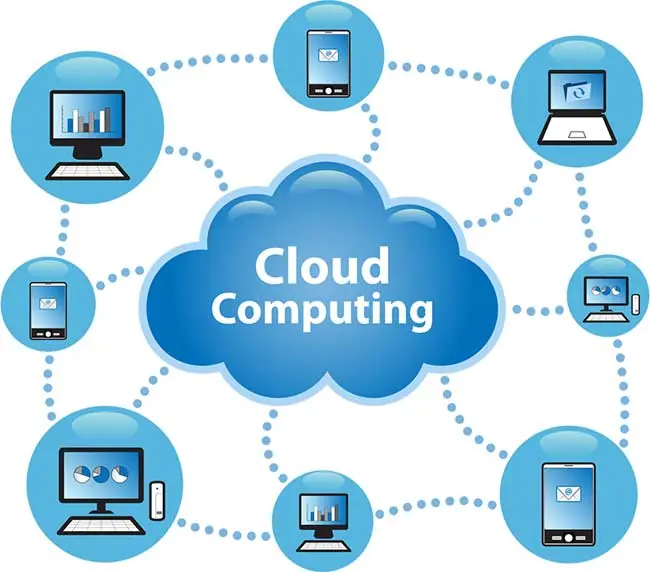
Cloud computing means using computing resources — servers, storage, databases, software — over the internet instead of running them on your own hardware. You rent what you need from a provider and usually pay per user or per use. There are three main service models:
- Software as a Service (SaaS): ready-to-use applications in the browser or as an app, such as Microsoft 365, Google Workspace, Salesforce or online accounting software. The provider takes care of everything behind the scenes.
- Platform as a Service (PaaS): a managed platform on which developers build and run their own applications without managing servers.
- Infrastructure as a Service (IaaS): virtual servers, storage and networks from providers such as Amazon Web Services, Microsoft Azure or Google Cloud, which you configure and manage yourself.
Why cloud computing makes business sense
- Lower upfront costs: no need to buy and maintain your own servers; you pay a predictable monthly fee and scale up or down as needed.
- Reliability and backup: major providers store data redundantly across several data centres, so a broken drive or a fire in your office doesn’t mean losing your data.
- Access from anywhere: employees can work from the office, home or on the road, on any device — the foundation of hybrid work and of bring-your-own-device policies.
- Always up to date: SaaS applications are updated automatically, including security fixes.
- Professional security: large providers invest far more in physical and technical security than most small businesses could.
- Focus on your core business: instead of maintaining IT infrastructure, your team can focus on customers and products.
- Access to new technology: cloud platforms make tools such as data analytics and artificial intelligence available without large investments.
What to watch out for
- Shared responsibility: the provider secures its infrastructure, but you’re responsible for user accounts, passwords, access rights and configuration. Turn on two-factor authentication and review who has access to what.
- Backups are still your job: many SaaS providers don’t protect you from accidental deletion or ransomware in your own account beyond a limited period. Consider a separate backup of important cloud data.
- Costs can grow: per-user subscriptions and pay-as-you-go resources add up. Review your licences and usage regularly.
- Data protection and location: check where your data is stored and whether the provider meets legal requirements such as the GDPR in Europe, including a data processing agreement.
- Vendor lock-in and internet dependence: moving between providers can be difficult, and without an internet connection you may not be able to work. Choose services with good export options and have a plan for outages.
Getting started
For most small businesses, the easiest first steps are cloud email and office software, file sharing, online accounting and automatic cloud backup. Start with a clear inventory of your data and applications, move step by step and train your staff. Done well, cloud computing makes your business more flexible, more resilient and more efficient.



















marco
Mar 07. 2014
There is no doubt that cloud computing is the future – the sooner we get on this boat, the better!
Stephan
Mar 09. 2014
Cloud computing is considered a future for technology, its benefits is so obviously that we should adapt it as soon as we can.
thanks for your information.
stephan
Sima
Jul 02. 2014
If you would like to take a good deal from this article then you have to apply these techniques to your won website.
Vijay
Aug 14. 2014
There is no any doubt that computing is the future
Sina
Jan 09. 2015
Keep on writing, great job!
Jenifer
Nov 28. 2015
Hi there, after reading this amazing piece of writing i am also cheerful to share my familiarity here with friends.