
There is no single best language learning app. Duolingo, Babbel, Busuu, Pimsleur and the others are built for different goals: a quick daily habit, conversation for a holiday, vocabulary for work, or speaking practice with a real teacher. Choosing the app that fits your goal matters more than any ranking.
This guide compares the most popular apps by what they are good at, shows which one to pick for travel, work, the home office or a creative job, and explains how to combine them so you actually learn to speak.
The most popular apps at a glance
- Duolingo: short, game-like lessons with streaks and leagues. Free with ads, paid plans remove ads and add features. Very good for building a daily habit and for beginners. Weaker for real conversation and grammar explanations.
- Babbel: subscription courses with clear grammar explanations and dialogues from everyday situations. Good for adults who want structure, including courses for business and travel topics, and optional live online classes.
- Busuu: structured courses plus a community feature: native speakers correct your written and spoken exercises. Good for getting feedback without booking a teacher.
- Pimsleur: audio-first lessons of about 30 minutes in which you answer out loud. Ideal for commuting, driving and anyone who learns by listening.
- Memrise: vocabulary and phrases with short videos of native speakers, so you hear how people really talk.
- Anki: free, open-source flashcards with spaced repetition. Not a course, but the most efficient way to remember large amounts of vocabulary, including your own words.
- italki and Preply: marketplaces for one-to-one video lessons with tutors. The fastest way to start speaking, paid per lesson.
Which app fits your goal?
Travel: speak enough to get around
For a trip in a few weeks, focus on listening and set phrases: greetings, ordering, directions, numbers and polite questions. Pimsleur or the travel courses in Babbel work best, because you practise speaking out loud from the first lesson. Add a translator app with downloaded languages for emergencies: our guide to the best translation apps for travel shows how to set them up for offline use.
Work and business
For meetings, e-mails and presentations you need correct grammar and the vocabulary of your field. A structured course such as Babbel or Busuu gives you the grammar, and a tutor on italki or Preply can prepare you for real situations such as a job interview or a sales call. Many tutors specialise in business English, German or Spanish.
Home office and busy schedules
If you work from home, you can fit learning into the gaps of the day: one lesson before the first call, ten minutes of flashcards at lunch, a podcast while walking. Apps with short lessons and reminders (Duolingo, Babbel) suit this rhythm. Block one or two fixed slots a week for a live lesson, because without speaking practice the progress stalls.
Photographers, designers and other creative jobs
Creative professionals often need a narrow but specialist vocabulary: light, composition, contracts, client briefings. General apps rarely teach these words. Build your own deck in Anki with the terms you need, add pictures to the cards, and practise client conversations with a tutor. Watching tutorials in the target language on your own topic is one of the most effective and enjoyable ways to learn.
Learning on a budget
You can get far for free: Duolingo’s free plan, Anki (free on desktop, Android and the web), podcasts and videos in the target language, and free language-exchange apps such as Tandem or HelloTalk for chatting with native speakers. Many public libraries also give members free access to paid language courses, so check your library card before you subscribe.
How long does it take?
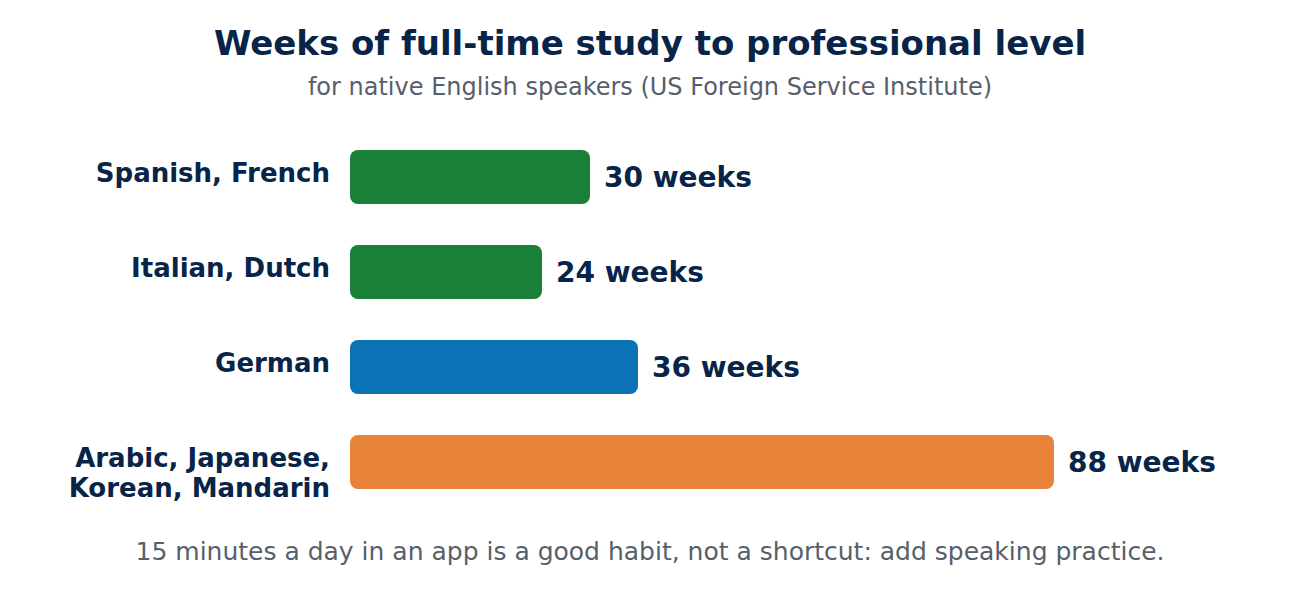
Apps are a great start, but realistic expectations help you stay motivated. The US Foreign Service Institute, which trains diplomats, estimates that an English speaker needs 24 to 30 weeks of full-time training (about 550 to 690 class hours) to reach professional working proficiency in languages closely related to English, such as Spanish, French or Italian. German takes about 36 weeks (828 hours), and Arabic, Japanese, Korean or Mandarin about 88 weeks (2,200 hours). Fifteen minutes a day in an app is a good habit, but on its own it will not make you fluent in a year.
How to combine apps for real progress
- One main course for structure and grammar (Babbel, Busuu or Duolingo).
- Flashcards with spaced repetition for vocabulary (Anki or the review feature of your course).
- Listening every day: podcasts, series with subtitles in the target language, or Pimsleur.
- Speaking every week: a tutor, a language exchange partner or a conversation class.
Speaking is the part most app learners skip, and it is the one that makes the biggest difference. Start early, even if you only know a few sentences.
Tips for choosing
- Test before paying. Most apps have a free trial or a free first lesson. Try two or three for a week each.
- Check your language. Not every app offers every language with the same depth. Popular languages have full courses, rare ones sometimes only basics.
- Look at subscription terms. Annual plans are much cheaper per month, but cancel the automatic renewal if you are unsure.
- Watch your privacy. Speech exercises upload recordings of your voice. Read what the app stores and turn off what you do not need.
Conclusion
Pick the app by your goal: Pimsleur or Babbel for travel, Babbel or Busuu plus a tutor for work, short daily lessons for a busy home office, and your own Anki deck for specialist vocabulary. Combine one course with flashcards, daily listening and weekly speaking, and the app becomes the start of real conversations instead of a streak counter.
Sources and further reading
- Foreign Language Training (US Department of State, Foreign Service Institute)
- Spaced repetition (Wikipedia)
- Anki (official website)

















Recent Comments