
This article was published in 2011 and updated in October 2026.
Your computer’s drive stores everything — your operating system, programs, photos and documents. Whether it’s a traditional hard disk drive (HDD) with spinning platters or a modern solid-state drive (SSD), every drive eventually wears out. With the right care you can extend its life, and with good backups a failure won’t cost you your data.
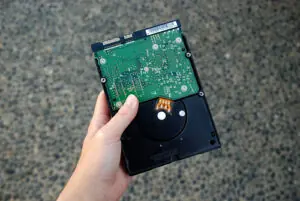
HDD or SSD: how they wear out
- Hard disk drives have moving parts: spinning platters and a read/write head that floats a tiny distance above them. Heat, vibration, shocks and simple mechanical wear eventually cause them to fail. Many last five years or more, but some fail much earlier.
- SSDs have no moving parts, so they’re much more resistant to bumps and drops. Their flash memory can only be written a limited number of times, but for normal home use modern SSDs typically outlast the computer they’re in. Manufacturers state the endurance as TBW (terabytes written).
1. Keep it cool
Heat shortens the life of any drive. Make sure your computer has good airflow: don’t block the vents, clean out dust every now and then and don’t use a laptop on a pillow or blanket. In desktop PCs, case fans should move air across the drives.
2. Protect it from shocks and vibration
Hard disks are especially sensitive to bumps while they’re running. Don’t move a desktop PC or knock a laptop while it’s working, mount drives securely, and carry external hard drives in a padded case. Switching to an SSD in a laptop removes this risk almost completely.
3. Use a surge protector or UPS
Power surges and sudden power cuts can damage drives and corrupt data. A good surge protector is cheap insurance; for a desktop PC or home server, an uninterruptible power supply (UPS) lets the computer shut down safely during a power cut.
4. Monitor the drive’s health
Drives record health data called S.M.A.R.T. values, such as reallocated sectors, temperature and, for SSDs, remaining endurance. Free tools such as CrystalDiskInfo on Windows show this at a glance, and Windows itself shows the estimated remaining life of many SSDs under Settings → System → Storage → Disks & volumes. Warning signs include clicking noises, frequent freezes, very slow file access and corrupted files — back up immediately if you notice them.
5. Leave some free space
A nearly full drive slows down, and SSDs need free space to manage wear evenly. Try to keep at least 10–20 percent free. Windows optimises drives automatically — there’s no need to defragment an SSD manually.
6. RAID helps — but it’s not a backup
In 2011 we suggested using an array of several drives. A RAID setup or a NAS with mirrored drives (RAID 1) does keep your files available if one drive fails, which is useful for home servers and small offices. But it doesn’t make individual drives last longer, and it doesn’t protect you from accidental deletion, ransomware or a power surge that damages all drives at once.
The most important tip: back up
No drive lasts forever, so the best protection is a good backup. Follow the 3-2-1 rule: keep three copies of important data, on two different types of storage, with one copy off-site — for example in the cloud. Then a dead drive is an inconvenience, not a disaster.















Olawale Daniel
Aug 03. 2011
This is a very nice article on improving the lives of our computer’s hard drives. Thanks Karen for the information shared 🙂
techGALAXY
Aug 03. 2011
Thanks for sharing… does defragmenting a disk affects the hard drive life??? if so , how?
admin
Aug 03. 2011
It depends … check this out http://forums.anandtech.com/archive/index.php/t-274833.html and http://forums.storagereview.com/index.php/topic/6741-defrag-does-it-decrease-the-life-of-your-drive/
techGALAXY
Aug 07. 2011
thanx for those links admin!! 🙂
android phones review
Aug 03. 2011
who run his computer most of the day, it need to proper cooling system (like extra cooling fan) for his desktop or laptop. for laptop, it you should shut down for a few times it, when u have no work on it. to keep overload your hard drive is not good. virus and slow pc is not good for your hard drive lasting. all this is my concept. good writing.
Priyangshu
Aug 03. 2011
Nice tips bro ! Does frequent formatting of hard drives destroys the hard drive ??
admin
Aug 03. 2011
Frequent formatting decreases the life of the hard drive … Once in 3-4 months or earlier if there is absolute necessity is recommended
Oracle
Aug 04. 2011
Thanks for sharing, i appreciate your efforts.
Anna from Cosmetic Dentistry
Aug 04. 2011
Good and easy to understand issue/tips, thanks Karen!
I’ve been doing a lot of hard disk defragmentation before but I have stopped doing it nowadays. Thanks for the link on that.
Bob
Aug 05. 2011
great …i am always troubling by this error ..hard drive burst….after all finally i found the solution ..ill use all the thing u said ..nice post keep uploading…
Theresa Torres
Aug 07. 2011
Hi Karen,
I recently brought my PC to the repair shop and the problem was the hard drive needs to be replaced. I think it was because of frequent formatting.
Thanks for sharing these tips. I’ll be more careful this time. Having a set of hard drives sounds like a good idea. I think I’ll get one or two spares.
Have a nice day!
Sandipan Mukherjee
Sep 07. 2011
Thanks for sharing. This is a very useful article.
Denver Real Estate
Oct 31. 2011
It was certainly interesting to know more on how to increase the life of hard disk. The post is very detailed and one don’t have to be a techie to understand this topic on hard disk.