
This article was published in 2012 and updated in October 2026.
Imagine your entire windscreen working as a transparent display, showing navigation arrows directly on the road ahead and highlighting hazards in the fog. In 2012 this was still a concept. Today head-up displays (HUDs) are common in new cars, and augmented-reality versions are already on the road. Here’s how HUDs developed — and where they’re heading.
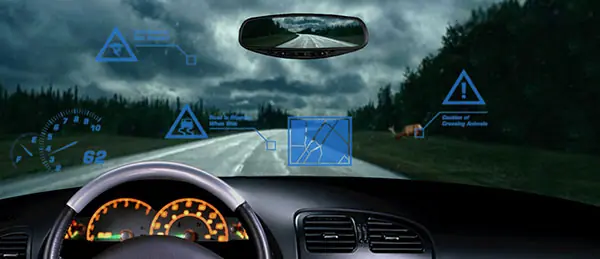
What is a head-up display?
A head-up display projects information into the driver’s field of view, so you don’t have to look down at the instruments. Originally developed for military aircraft, the name comes from the pilot’s ability to keep their head “up”, looking forward. HUDs help pilots fly more safely at night and in poor weather — and help drivers keep their eyes on the road.
From aviation to the car
In 1988, General Motors put a HUD into the Oldsmobile Cutlass Supreme Indy 500 pace car and a small number of replicas. Toyota followed in 1991 in its Crown Majesta, the Corvette got the first colour HUD in 1998, and BMW offered a multicolour HUD with navigation in the 5 Series from 2003. Since then, HUDs have spread from luxury cars to many mid-range and even compact models.
Augmented-reality HUDs
The biggest step since 2012 is the augmented-reality (AR) HUD. Instead of a small information field, it projects graphics that appear to lie on the road ahead — for example navigation arrows directly on the lane you need to take, or markings that highlight the car in front when adaptive cruise control is active. Mercedes-Benz, Volkswagen and other manufacturers have offered AR HUDs since around 2020. Some new models go further and use the entire lower edge of the windscreen as a wide display band.
Add-on and smartphone HUDs
If your car doesn’t have a HUD, you can buy an add-on unit that sits on the dashboard and projects speed and navigation onto a small transparent screen (a “combiner”). Smartphone apps that mirror your speed onto the windscreen are cheaper but only work well at night. Keep in mind that a phone or device mounted on the dashboard must not block your view and must be operated in a way that complies with local traffic laws.
Safety: help or distraction?
Studies suggest that well-designed HUDs help drivers keep their eyes on the road and react faster than when looking down at a dashboard screen. But too much information can distract. The best systems show only what matters right now — speed, the next turn, warnings — and let drivers adjust brightness, position and content.
What about smart glasses?
In 2012, Google planned to bring its Project Glass headset to consumers. The consumer version of Google Glass never caught on and was discontinued, but smart glasses with displays and AR features from several companies are now on sale. For drivers, built-in car HUDs remain the safer and more practical option.
Suggested reading:
- Google’s first Project Glass sees the light
- Smart glasses: future technology
- Top five technological advancements to look forward to in 2013














Mike
Oct 19. 2012
This is my dream having such a wide transparent head up display on my windshield! Nice future technology to become reality
Tech Crates
Oct 22. 2012
Thanks Mike! This really sounds like science fiction and we are the first generation who will actually join this Sci-Fi 🙂
Jason
Oct 22. 2012
I wonder if having a HUD in a car would actually increase car accidents. People (myself included) have trouble focusing on driving while on a cell phone, imagine watching Youtube or reading news while driving. Would be fun though 🙂
Tech Crates
Oct 22. 2012
This is indeed a very good question. There is definitely a higher risk as the driver might be disturbed or is busy with processing all the information. I guess there will be other driving assistant applications in the car to handle worst cases. Thanks for your great comment Jason!
Jesse
Aug 23. 2013
This concept is so darn cool! I really hope to not only see this in car windshields, but even in our sunglasses/glasses while walking around.
We keep getting closer and closer to technology all coming together. It’s a slow process in some ways.
I believe there is a bit of a risk to it, but maybe drivers should be retrained to learn to drive with a new HUD display. Thanks for the post!
Tech Crates
Aug 23. 2013
Love it and waiting to hit the consumer market 🙂 Hopefully for affordable prices that families can benefit from increased security of a HUD display 🙂
Anthony
Nov 26. 2013
Great technology. It will be very useful but I hope it will not be a distraction for drivers. Thanks for the great information.
Raju
May 30. 2014
Audi is famous car and very attractive, desirable model. HUD in car may cause increase in road accident. The drive may not concentrate on driving while watching HUD, but it is even good feature
John Musson
Sep 24. 2015
I have a 2002 Buick with HUD it only displays speed & turn indicators – I love it. After a while driving, the display is there but not distracting; you just know your speed and are aware of turn indicators – I never forget to cancel them after a lane change.
More data would be useful – not extraneous data or entertainment – navigation and vehicle status and other important peripheral status.
matouq
Oct 08. 2015
can i buy it ?
matouq sagga
Oct 08. 2015
i have dodge charger can i get one .
hey
Feb 19. 2016
yo