
An ID card, driving licence, proof of age or professional qualification on your phone, accepted wherever you go: that is the promise of digital identity wallets. The EU and the UK are taking quite different routes. In the EU, every member state must offer an EU Digital Identity Wallet by the end of 2026. In the UK, the government dropped its planned national digital ID in 2026, while GOV.UK One Login, the GOV.UK Wallet and certified private providers carry on. This guide explains how such wallets work, how certificates and signatures protect the data, what each side has decided and what it means for privacy.
How an identity wallet works
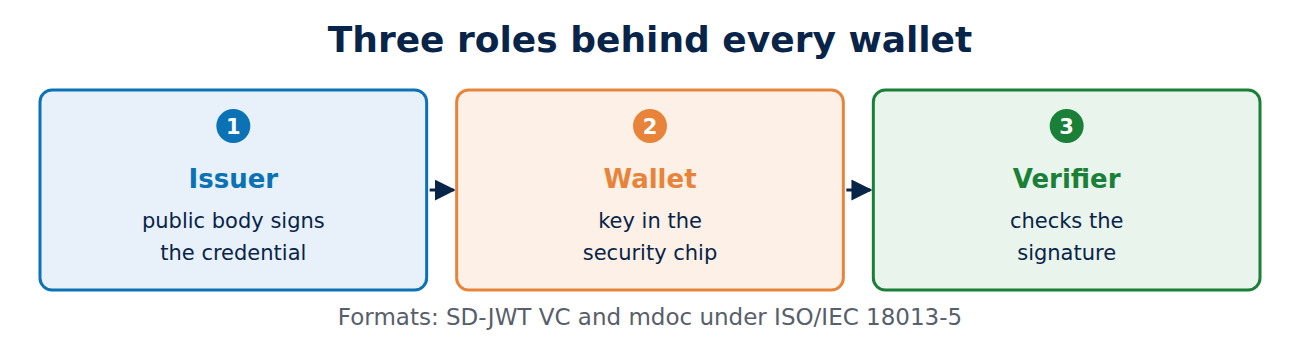
Whatever the country, wallets share the same model with three roles:
- Issuer: a public body or trusted provider issues identity data or another credential and signs it. The data is bound to a key the wallet generated in the phone’s security chip.
- Holder: the wallet stores the credentials and only releases them with the person’s consent, unlocked with a PIN or biometrics.
- Verifier (relying party): an online shop or bank checks the issuer’s signature and the proof that the data comes from this particular wallet.
Technically, wallets use two main formats: SD-JWT VC (verifiable credentials based on JSON Web Tokens) and mdoc under ISO/IEC 18013-5, the standard for mobile driving licences. For JWTs see OAuth 2.0 and OpenID Connect explained, and for chains of trust how the certificate chain of trust works.
Share only what is needed
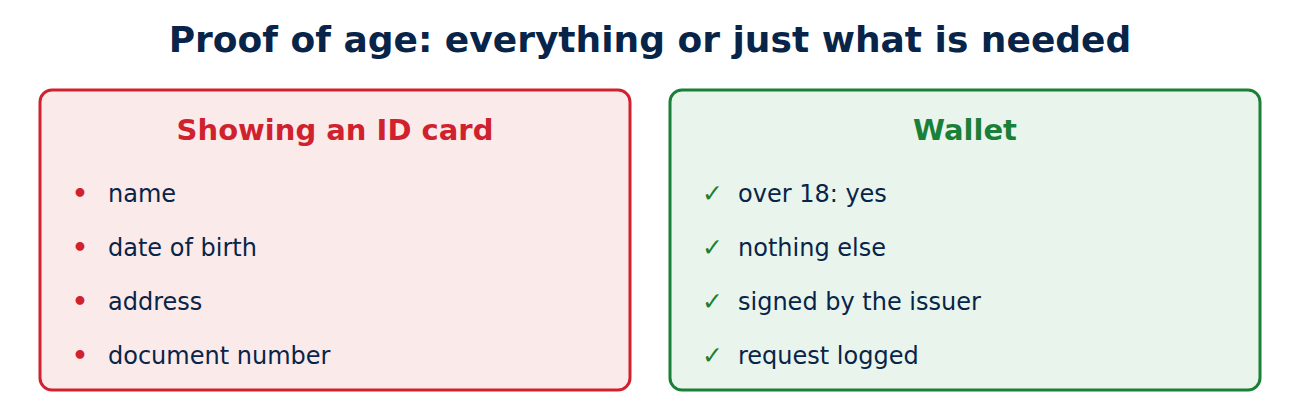
A key principle is selective disclosure. When buying alcohol, the wallet does not have to hand over name, address and date of birth, only confirm “over 18”. The individual items are hashed and signed separately, so the wallet can present some of them without breaking the signature. Good wallets also keep a log of every request that the user can view, and avoid letting the wallet provider see where it is used.
The EU: eIDAS 2.0 and the EUDI Wallet
The revised eIDAS Regulation, often called eIDAS 2.0 (Regulation (EU) 2024/1183), entered into force on 20 May 2024. Its main points:
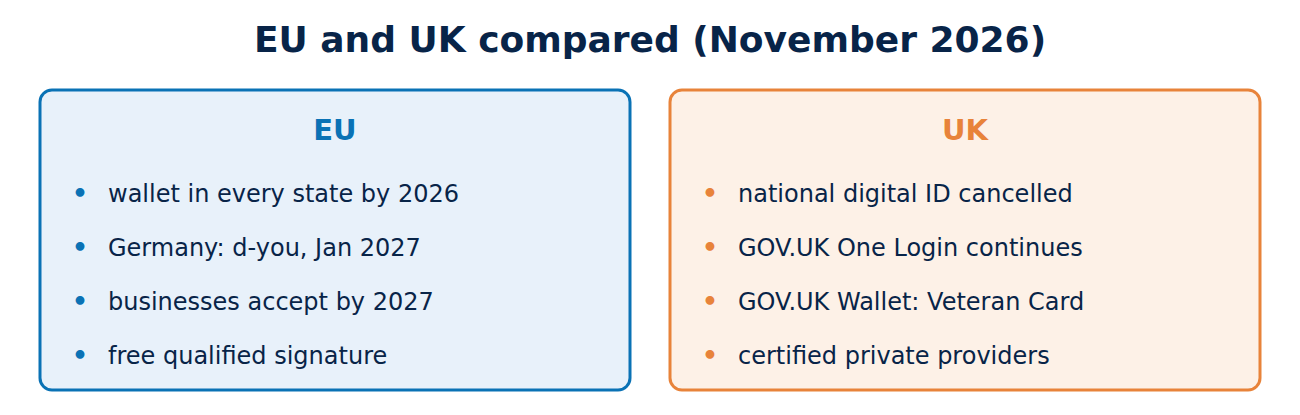
- Duty on member states: each must provide at least one EUDI Wallet, free and voluntary for citizens, by the end of 2026. In autumn 2026 many countries were reported to be behind schedule. Germany plans to launch its state wallet, “d-you”, on 2 January 2027.
- Duty on many businesses: banks, insurers, telecoms, health services and other sectors that require strong authentication, as well as very large online platforms, must accept the wallet by the end of 2027 if customers want to use it.
- Signing: citizens can create qualified electronic signatures free of charge for private use, legally equivalent to a handwritten signature.
- Credentials: besides identity, the wallet can hold further attestations such as driving licences, qualifications or memberships.
Verifiers must register in their country and receive access certificates, so the wallet can show who is asking and which data they are allowed to request. The regulation also requires pseudonyms for services that do not need a real identity, and a way for users to report a request to their data protection authority.
The UK: One Login, GOV.UK Wallet and certified providers
The UK has taken a more mixed route:
- National digital ID: announced in September 2025 as a mandatory credential for right-to-work checks, made optional in January 2026 and cancelled in July 2026, according to the House of Commons Library.
- GOV.UK One Login: the single sign-in for government services, used to prove identity online for an increasing number of services. It continues.
- GOV.UK Wallet: the government’s own wallet app for official credentials. It launched with the Veteran Card, and a digital driving licence is being trialled.
- Certified private providers: the Digital Verification Services trust framework certifies private identity apps, which employers and landlords can use, for example for right-to-work and right-to-rent checks.
UK credentials do not work in the EU wallet system and vice versa, although both build on similar standards.
What you can use a wallet for
- Proving identity online: opening a bank account, activating a SIM card or using public services without a video call or a trip to a post office.
- Proof of age: in a shop or online, with only the necessary detail.
- Signing: rental agreements or applications, in the EU with a qualified signature.
- Showing credentials: driving licence, certificates or professional cards, once issuers offer them.
Wallets also matter for scams: anything that proves identity is a target, so treat requests for wallet data like requests for passwords; see what to do if your identity is stolen and how to set up two-factor authentication.
Frequently asked questions
Do I have to use a digital wallet?
No. In the EU use is voluntary and must not put anyone at a disadvantage, and in the UK the plans for a mandatory digital ID were dropped. Physical documents remain valid.
What happens if I lose my phone?
Credentials can be revoked and issued again on a new device. Without the PIN or biometrics, a finder cannot use the wallet.
Can I use an EU wallet as a British citizen?
Only if you live in an EU country that issues one to residents. The UK has no EUDI wallet.
Is GOV.UK Wallet the same as One Login?
No. One Login is the sign-in for government services; the wallet stores official credentials on your phone.
Conclusion
Identity wallets store signed credentials on the phone, bound to protected keys, and let you share only what is needed. The EU requires every member state to offer one by the end of 2026, with businesses obliged to accept them by the end of 2027. The UK dropped its national digital ID but continues with One Login, the GOV.UK Wallet and certified private providers. More guides in the hub Online security and privacy.
Sources and further reading
- Regulation (EU) 2024/1183 (EUR-Lex)
- European Digital Identity Regulation (European Commission)
- Digital ID in the UK (House of Commons Library)
- UK digital verification services trust framework (GOV.UK)












Recent Comments