
A smart plug, an industrial sensor or an EV charger has no keyboard and no user to type a password. Yet the cloud service needs to know it is talking to a genuine device and not a fake. The answer is device identity: certificates that go into the device at the factory. This guide explains the IEEE 802.1AR standard with IDevID and LDevID, how manufacturers get keys into devices safely, how the smart home standard Matter checks devices with DAC, PAI and PAA, and what UK and EU law now requires.
The problem: millions of devices without passwords
Many devices used to ship with a default password such as admin, printed in every manual. In 2016 the Mirai botnet took over hundreds of thousands of cameras and routers in exactly that way. A real device identity works differently: each device has its own key pair, the private key sits protected inside a chip, and a certificate from the manufacturer confirms the serial number and model. The device proves its identity with a signature, with no password at all. For the principle see what is an X.509 certificate.
IEEE 802.1AR: IDevID and LDevID
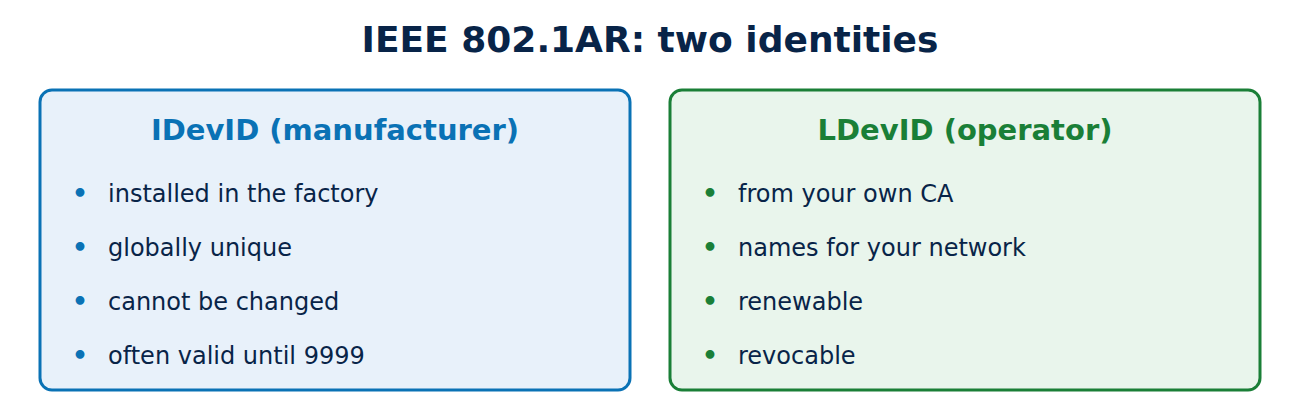
The IEEE 802.1AR standard (current edition 2018, “Secure Device Identity”) describes two kinds of identity:
- IDevID (Initial Device Identifier): installed by the manufacturer at the factory, globally unique and unchangeable. The certificate usually names the manufacturer, model and serial number, and often lasts as long as the device, sometimes with the expiry date 31/12/9999 that RFC 5280 reserves for “no expiry”.
- LDevID (Locally significant Device Identifier): issued by the operator, for example by the organisation’s own CA. It carries names and permissions that apply on that network and can be renewed and revoked.
So the IDevID serves as the credential for first contact and the LDevID for everyday use. Both are intended for network sign-in with EAP and other provisioning protocols. The standard requires that the private key cannot be read out, for example because it lives in a TPM or secure element; see what is an HSM.
From factory certificate to operator certificate
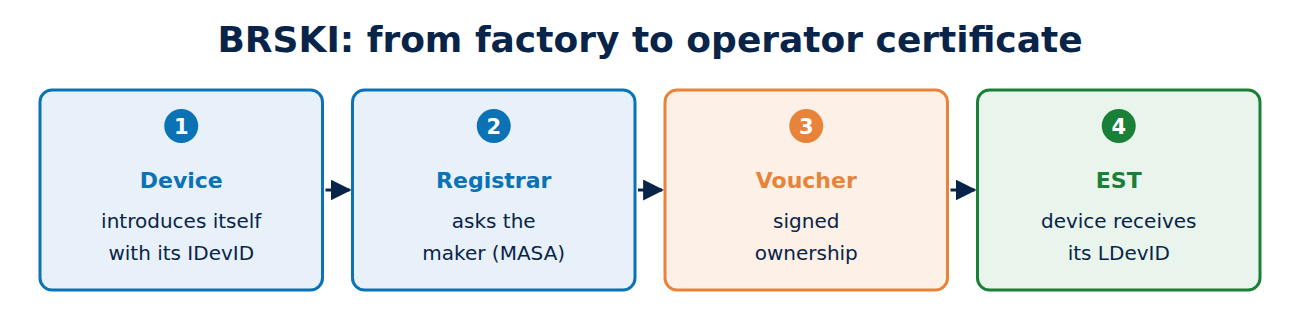
How does an IDevID become an LDevID? One standardised route is BRSKI (Bootstrapping Remote Secure Key Infrastructure, RFC 8995):
- The new device introduces itself with its IDevID to a registration authority on the company network.
- The registration authority asks the manufacturer’s service (MASA) for a voucher, a signed confirmation that this device belongs to this organisation.
- The device checks the voucher and then trusts the company network.
- Using EST, it requests its LDevID; see what is EST.
In industry, CMP is a common alternative; see what is CMP. Cloud platforms such as AWS IoT or Azure IoT Hub use simpler schemes: the manufacturer registers the device certificates, or its CA, with the platform, and the device signs in with mutual TLS.
Keys in the factory: provisioning
The trickiest step is called provisioning: getting a key and certificate into every device without anyone in the factory being able to copy them. Two methods are common:
- Generate the key in the chip: the secure element creates the key pair itself and only releases the public key. The production line sends a request to the manufacturer’s CA and writes the certificate back.
- Pre-provisioned chips: semiconductor vendors supply secure elements that already contain key and certificate. The device maker only receives the list of certificates.
The manufacturer’s CA is usually kept offline, with its key in an HSM; see how to run a private certificate authority.
Matter: DAC, PAI and PAA
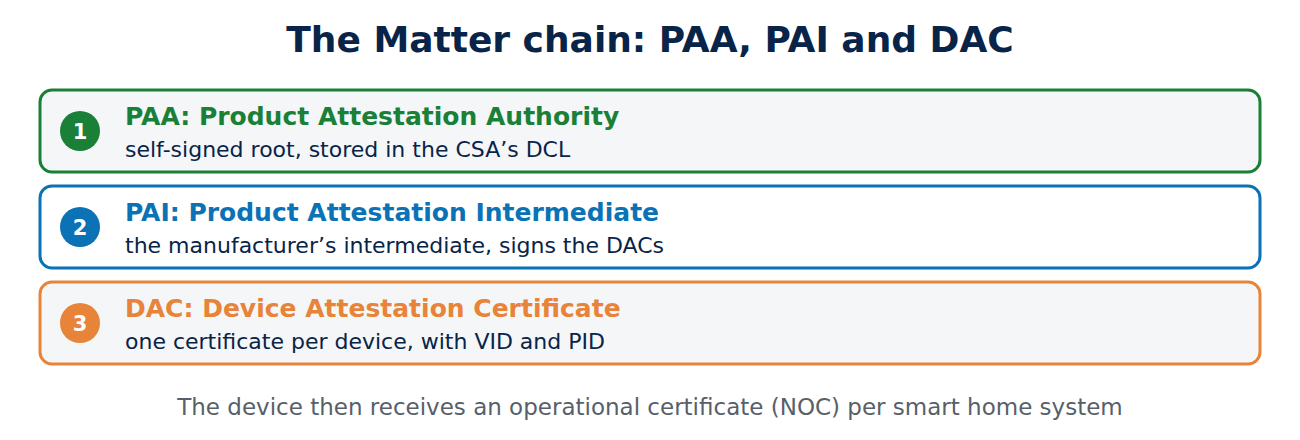
The smart home standard Matter requires every certified device to prove where it comes from before it joins a network. It uses a three-level chain:
- DAC (Device Attestation Certificate): the certificate of the individual device, with vendor ID (VID) and product ID (PID).
- PAI (Product Attestation Intermediate): the manufacturer’s intermediate certificate that signs the DACs, for example one per product line.
- PAA (Product Attestation Authority): the self-signed root.
Which PAAs are trusted is recorded in the Distributed Compliance Ledger (DCL) of the Connectivity Standards Alliance. During set-up, the app or hub (the commissioner) checks the DAC, PAI and PAA chain against the DCL, compares VID and PID, and has the device sign a random number with its DAC key. Only then does the device receive an operational certificate (NOC) from the smart home system in question. A device can therefore belong to Apple Home, Google Home and Amazon Alexa at once, with a separate operational certificate for each. For more on Matter see what is Matter.
What the law requires
In the UK, the Product Security and Telecommunications Infrastructure (PSTI) regime has applied since 29 April 2024: connectable consumer products may no longer ship with universal default passwords, and manufacturers must publish how to report vulnerabilities and how long updates will be provided. In the EU, security requirements under the Radio Equipment Directive have applied to internet-connected radio equipment since 1 August 2025. The Cyber Resilience Act goes further: since 11 September 2026 manufacturers must report actively exploited vulnerabilities, and from 11 December 2027 its full requirements apply to products with digital elements sold in the EU, including those made by UK firms. Unique, protected device identities help with secure updates and sign-in.
Frequently asked questions
Does an IDevID never expire?
Many are valid until 9999, because a device can run for decades. That is why it is only used for first contact; everyday use relies on a renewable LDevID.
What happens if a manufacturer key is stolen?
An attacker could then pass off fakes as genuine. The manufacturer must revoke the affected intermediate CA; with Matter it is revoked in the DCL.
Does every Matter device need its own certificate?
Yes, every certified device has its own DAC with its own key.
Is a device identity the same as a serial number?
No. Anyone can copy a serial number. An identity is proved with a private key that nobody can read out.
Conclusion
Device identity means one key pair per device, protected in the chip and confirmed by a manufacturer certificate. IEEE 802.1AR separates the fixed factory IDevID from the operator’s renewable LDevID, BRSKI, EST and CMP connect the two, and Matter checks every smart home device through DAC, PAI and PAA. More guides in the hub Certificates, PKI and encryption.
Sources and further reading
- 802.1AR: Secure Device Identity (IEEE 802)
- RFC 8995: Bootstrapping Remote Secure Key Infrastructure (BRSKI) (IETF)
- Matter device attestation (Google Home Developers)
- The UK Product Security and Telecommunications Infrastructure (PSTI) regime (GOV.UK)














Recent Comments