
The ACME protocol (RFC 8555) brought HTTPS to everyone: a program on the server automatically proves to the certificate authority that it controls the domain, then collects the certificate. The basics are covered in the ACME protocol and certificate automation. This guide goes further: the three validation methods in detail and when to use each, External Account Binding for commercial CAs, ACME Renewal Information (RFC 9773) for renewing at the right moment, and Let’s Encrypt’s certificate profiles.
The three challenges at a glance
Before a CA issues a certificate, the ACME client has to solve a challenge. It is always built on the key authorisation: a random token from the CA, a full stop and the fingerprint of the account key. That tells the CA that this particular account controls the domain.
- HTTP-01: the client places the key authorisation at http://example.co.uk/.well-known/acme-challenge/TOKEN. The CA fetches the file over port 80.
- DNS-01: the client sets a TXT record at _acme-challenge.example.co.uk. It holds the SHA-256 hash of the key authorisation, base64url-encoded and therefore exactly 43 characters long.
- TLS-ALPN-01 (RFC 8737): the server answers on port 443 with a special self-signed certificate when the CA asks for the acme-tls/1 protocol. Port 80 is not needed.
A DNS-01 record looks like this (value as an example):
_acme-challenge.example.co.uk. 300 IN TXT "LoqXcYV8q5ONbJQxbmR7SCTNo3tiAXDfowyjxAjEuX0"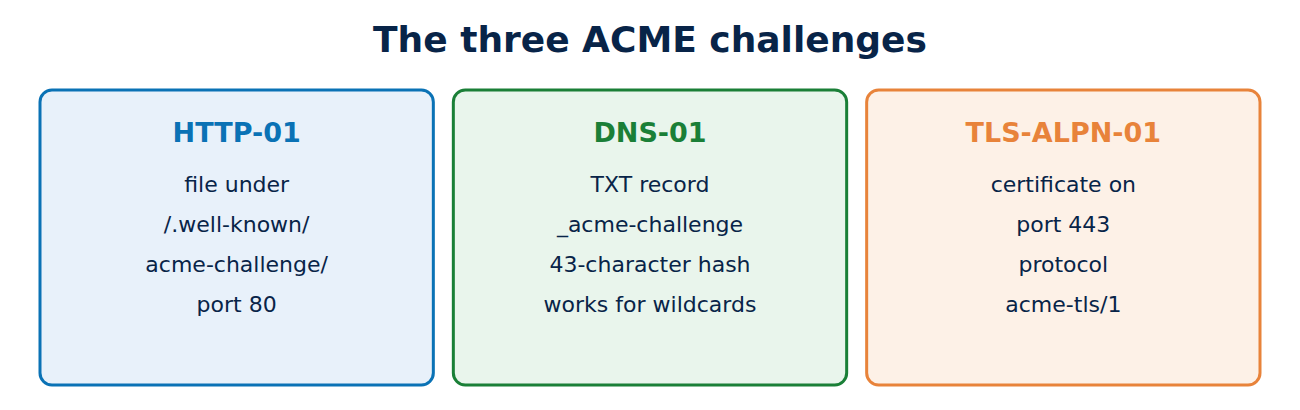
Which challenge when?
- HTTP-01 is the simple default for individual web servers. It needs port 80 reachable and does not work for wildcard certificates.
- DNS-01 is the only option for wildcards and for servers that cannot be reached from the internet, such as those on a company network. The client needs access to the DNS zone, usually through the DNS provider’s API. It is safer to delegate the _acme-challenge name by CNAME to a small zone of its own, so that the client cannot change the whole domain. For wildcards see what are SAN and wildcard certificates.
- TLS-ALPN-01 suits servers and reverse proxies that handle TLS themselves, such as Caddy or Traefik, when port 80 is blocked.
Since 2025, the CA/Browser Forum’s rules require CAs to confirm validation from several network locations (Multi-Perspective Issuance Corroboration). An attacker who diverts only part of the internet’s routing can hardly fool the check any more. In addition, the time for which a passed validation may be reused is shrinking in steps to ten days by 2029; see why certificate lifetimes are getting shorter.
External Account Binding: ACME with commercial CAs
With Let’s Encrypt, the client simply creates an account. Commercial CAs need to know which customer is paying. That is what External Account Binding (EAB) is for: the customer receives a key ID and a secret HMAC key in the CA’s web portal. When creating the account, the ACME client uses them to sign the account’s public key, linking the ACME account to the customer account. With Certbot it looks like this (values as examples):
certbot register --server https://acme.ca-example.co.uk/directory --eab-kid kid-4711 --eab-hmac-key c2VjcmV0X2htYWNfa2V5X2V4YW1wbGUEAB is used, for example, by ZeroSSL, Google Trust Services, Sectigo and DigiCert, and by many private CAs that only want known clients.
ACME Renewal Information: renewing at the right time
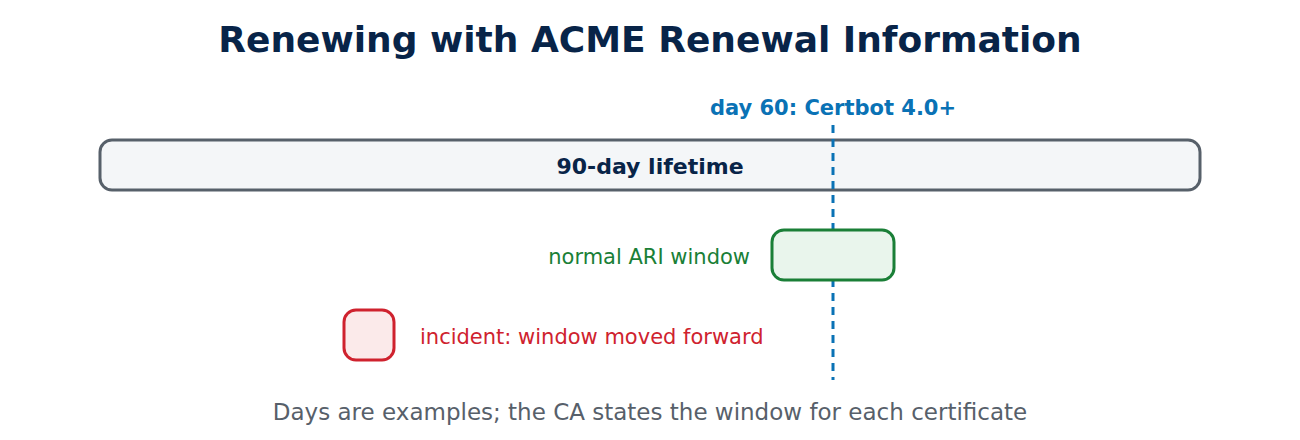
When should a client renew? Certbot used to renew 30 days before expiry. Since version 4.0 it renews when a third of the lifetime remains, after 60 days for a 90-day certificate. Better still is to let the CA say when. That is what ACME Renewal Information (ARI) does, standardised as RFC 9773 in June 2025. The CA lists a renewalInfo endpoint in its directory, and the client asks it for a suggested renewal window for each certificate.
The benefit shows when something goes wrong. If a CA has to revoke many certificates, the Baseline Requirements often give site owners only five days. With ARI, the CA simply moves the window forward and every ARI-aware client renews by itself before the revocation. ARI also spreads renewals over time and avoids load spikes. Certbot has checked ARI since version 4.1, and Caddy and lego support it too.
Profiles: certificates to order
ACME profiles let the client choose what kind of certificate it gets. Let’s Encrypt currently offers:
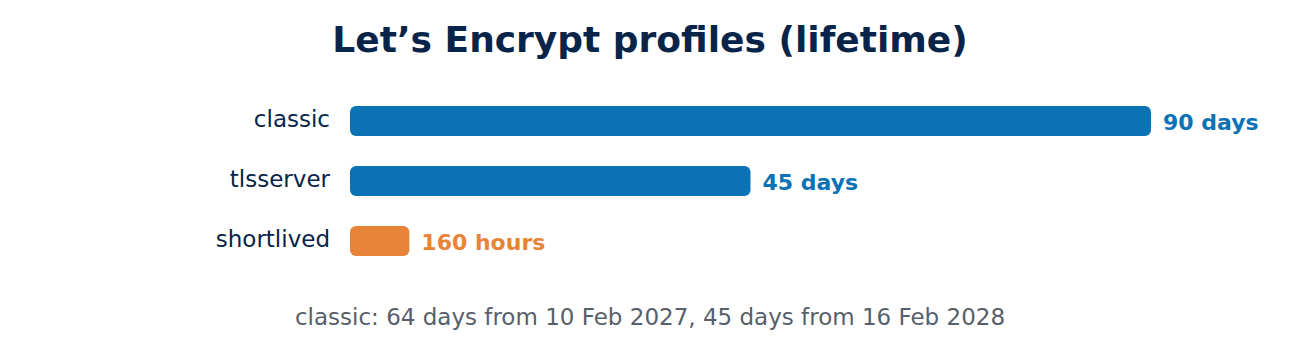
- classic: the default for anyone who does not ask for something else, currently 90 days. It drops to 64 days on 10 February 2027 and to 45 days on 16 February 2028.
- tlsserver: 45 days, and already built to the latest recommendations of the Baseline Requirements.
- shortlived: 160 hours, just under seven days, generally available since January 2026. Short-lived certificates make revocation almost unnecessary; see how certificate revocation works.
The former tlsclient profile for client certificates was withdrawn on 8 July 2026. In Certbot 4.0 or later, a profile is chosen like this:
certbot certonly --webroot -w /var/www/html -d example.co.uk --preferred-profile shortlivedAnyone using six-day certificates needs reliable automation with monitoring, or the certificate will expire over a weekend.
Frequently asked questions
Which challenge is the most secure?
All three are secure when set up properly. With DNS-01, access to the DNS API is the weak point; a delegated sub-zone limits the damage.
Do I have to open port 80?
Only for HTTP-01. DNS-01 needs no open port, TLS-ALPN-01 only port 443.
What happens if my client does not support ARI?
It carries on renewing on its own schedule. In a mass revocation you then have to renew by hand.
Can I use ACME on a company network?
Yes, with your own ACME-capable CA such as step-ca, using DNS-01 or internal HTTP access; see how to run a private certificate authority.
Conclusion
ACME is more than Let’s Encrypt with default settings: HTTP-01 for simple web servers, DNS-01 for wildcards and internal servers, TLS-ALPN-01 for proxies without port 80. EAB ties ACME to commercial customer accounts, ARI lets the CA steer the renewal time, and profiles offer lifetimes down to seven days. More guides in the hub Certificates, PKI and encryption.
Sources and further reading
- RFC 8555: Automatic Certificate Management Environment (IETF)
- RFC 9773: ACME Renewal Information Extension (IETF)
- Challenge Types (Let’s Encrypt)
- Profiles (Let’s Encrypt)

















Recent Comments