
SCEP automated device certificates but carries old baggage: its own encryption over plain HTTP and a weak challenge password. Its successor is EST, Enrollment over Secure Transport, standardised as RFC 7030 in October 2013. EST simply uses HTTPS, handles renewal cleanly with the existing certificate and can even generate the key on the server if needed. This guide explains the EST endpoints, how clients sign in, how renewal works and where EST is used.
The idea: HTTPS instead of a home-made scheme
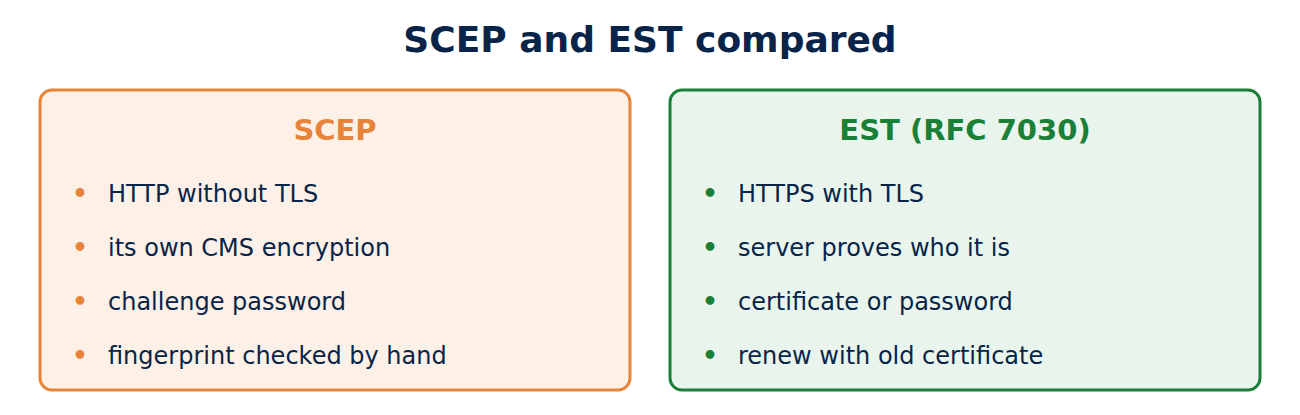
SCEP encrypts each message itself, because around 2000 many devices could not do TLS; see what is SCEP. EST leaves protection of the connection to TLS, the same technology as HTTPS. That has three advantages:
- The server proves who it is: the client checks the EST server’s TLS certificate before sending anything; see how the certificate chain of trust works.
- The client can prove who it is: with an existing certificate, as in mutual TLS, or with a username and password.
- Familiar tools: web servers, load balancers and TLS libraries exist everywhere.
The EST endpoints
All requests live under a fixed path, /.well-known/est/. The main operations are:
- cacerts: returns the current CA certificates. This is how a new device learns which CA to trust.
- simpleenroll: the first request. The client POSTs a PKCS#10 CSR and receives its certificate.
- simplereenroll: renewal. The client signs in with its still-valid certificate and sends a new CSR.
- csrattrs: the server says which fields and algorithms it expects in the CSR, such as a particular curve.
- serverkeygen: the server generates the key pair and returns key and certificate. This helps very simple devices, or cases where the key must be escrowed for recovery.
- fullcmc: full requests in the CMC format (RFC 5272) for complex cases; rarely used.
The replies are base64-encoded PKCS#7 containers. Fetching and displaying the CA certificates looks like this (server name as an example):
curl https://est.example.co.uk/.well-known/est/cacerts -o cacerts.b64
openssl base64 -d -in cacerts.b64 | openssl pkcs7 -inform DER -print_certs
The container type is explained in certificate file formats explained. A request is just as plain:
curl --cacert ca.pem --user device17:OneTimePassword --data-binary @request.b64 -H "Content-Type: application/pkcs10" https://est.example.co.uk/.well-known/est/simpleenroll -o certificate.b64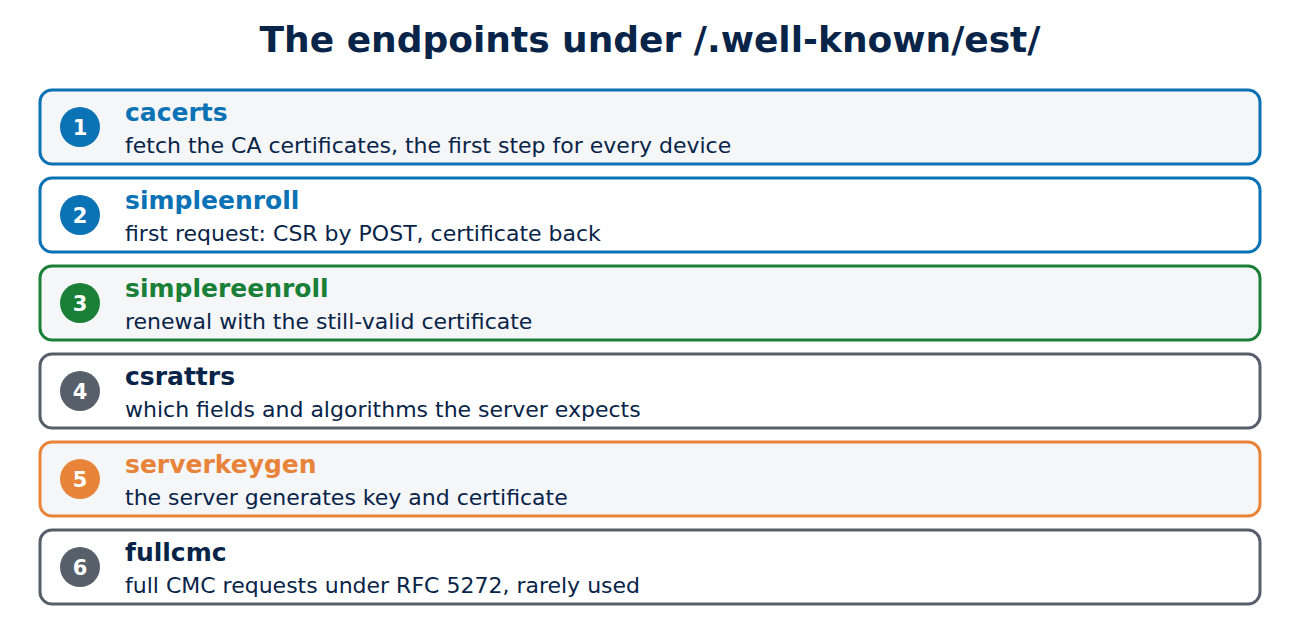
Who may request a certificate?
EST separates two questions neatly: who is the server, and who is the client? The client checks the server through TLS. For the client, RFC 7030 offers two routes:
- Certificate: a device that already holds a certificate signs in with it. That can be a manufacturer certificate installed in the factory (more on that in the guide to IoT device identity), or the current certificate at renewal time.
- Password: HTTP authentication with a username and password, ideally a one-time password per device.
One trick stops an attacker pushing someone else’s CSR through their own authenticated connection: the client can put a value from the TLS session (tls-unique) into the CSR as its challenge password. The server then sees that the CSR and the connection belong together. The server can also answer a request with HTTP status 202 and ask the client to come back later, if a person has to approve it.
Renewing with simplereenroll
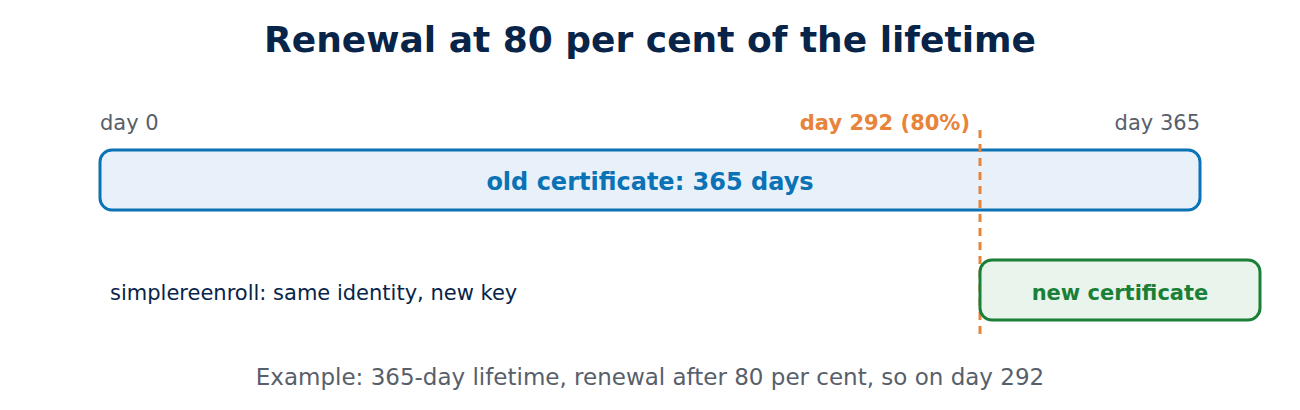
EST’s real strength is renewal. The device signs in over TLS with its old certificate, generates a new key pair and sends a new CSR for the same name. No new password and no person are needed. For example, with a lifetime of 365 days and renewal after 80 per cent of that time, the device replaces its certificate after 292 days. If a certificate does expire, it can no longer be used to sign in, and the device needs a password or an administrator again. Why timely renewal matters is covered in how to manage certificate expiry.
Where EST is used
- Network equipment: Cisco and other vendors support EST for routers, switches and access points.
- Internet of Things: for very small devices there is EST-coaps (RFC 9148), which runs over the lightweight CoAP protocol and DTLS.
- Zero-touch onboarding: BRSKI (RFC 8995) uses EST so that a new device can safely obtain an operator certificate using its manufacturer certificate.
- CA software: EJBCA and many commercial PKI products offer EST endpoints, and Cisco publishes libest, an open-source client and server library.
By comparison, SCEP is older and more widespread, while CMP can do more and is used in industry and mobile networks. For web servers with public certificates, ACME remains the standard.
Frequently asked questions
Is EST more secure than SCEP?
Usually, yes. TLS protects the connection and authenticates the server, and the device can sign in with a certificate rather than a shared password.
Should I use serverkeygen?
Only if the device cannot generate good keys itself or escrow is required. Otherwise a key that never leaves the device is safer.
What is RFC 8951?
A clarification of RFC 7030 from 2020 that, among other things, settles exactly how replies are encoded.
Does EST replace ACME?
No. ACME checks control of a domain and is built for public web certificates. EST is aimed at devices in a private PKI.
Conclusion
EST puts device certificates on a solid footing: TLS protects the connection, the client signs in with a certificate or password, and renewal runs on the old certificate without any human involvement. With six endpoints under /.well-known/est/ the protocol is easy to grasp. More guides in the hub Certificates, PKI and encryption.
Sources and further reading
- RFC 7030: Enrollment over Secure Transport (IETF)
- RFC 8951: Clarification of Enrollment over Secure Transport (IETF)
- RFC 9148: EST-coaps (IETF)
- RFC 8995: BRSKI (IETF)













Recent Comments