
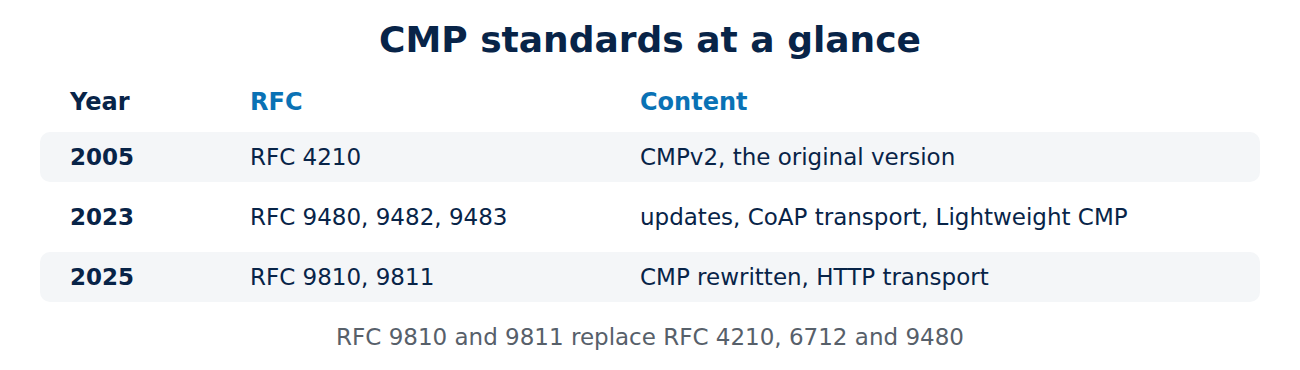
Factory floors, mobile base stations and power grids are full of devices that run for decades and still have to prove who they are. For environments like these there is the Certificate Management Protocol, or CMP. It is the most complete of the certificate enrolment protocols: it can request, renew and revoke certificates, pass requests through intermediaries and even work offline. Standardised in 2005 as RFC 4210, it was modernised in 2023 with RFC 9480 and a slimmed-down profile, Lightweight CMP (RFC 9483), and rewritten as RFC 9810 in July 2025. This guide explains how CMP is built, its main messages and where it is used.
CMP compared with SCEP and EST
SCEP and EST mostly handle two things: requesting and renewing a certificate; see what is SCEP and what is EST. CMP covers the whole lifecycle:
- Initial request, using a shared secret or a manufacturer certificate,
- Key update with the old certificate,
- Revocation requested by the device itself, for example if it suspects key theft,
- Queries for current CA certificates, revocation lists or request templates,
- Forwarding through one or more registration authorities (RAs) that check and add to requests.
A second difference: CMP protects each message itself, with a signature or with a MAC based on a shared secret. That means it is not tied to a connection and works over HTTP, CoAP or even by file transfer when a device has no direct route to the CA.
How a CMP message is built
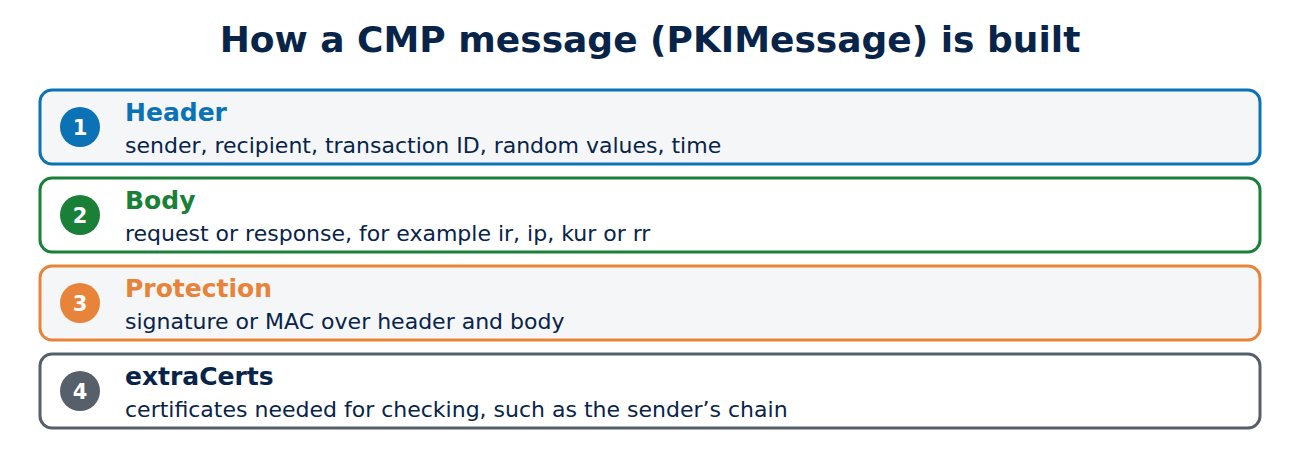
Every message (a PKIMessage) has four parts:
- Header: sender, recipient, transaction ID, random values against replay and a timestamp.
- Body: the actual content, such as a request or a response.
- Protection: a signature or MAC over header and body.
- extraCerts: certificates the recipient needs for checking, such as the sender’s chain.
Requests use the CRMF format (RFC 4211), which can carry more than an ordinary CSR; PKCS#10 is allowed for compatibility. For CSRs see how to create a private key and CSR.
The main message types
CMP works in request and response pairs:
- ir / ip: initialisation request and response, a device’s first request.
- cr / cp: a further request from a device that already holds a certificate.
- kur / kup: key update, a new key pair for an existing certificate.
- p10cr: a request carrying a classic PKCS#10 CSR.
- rr / rp: revocation request.
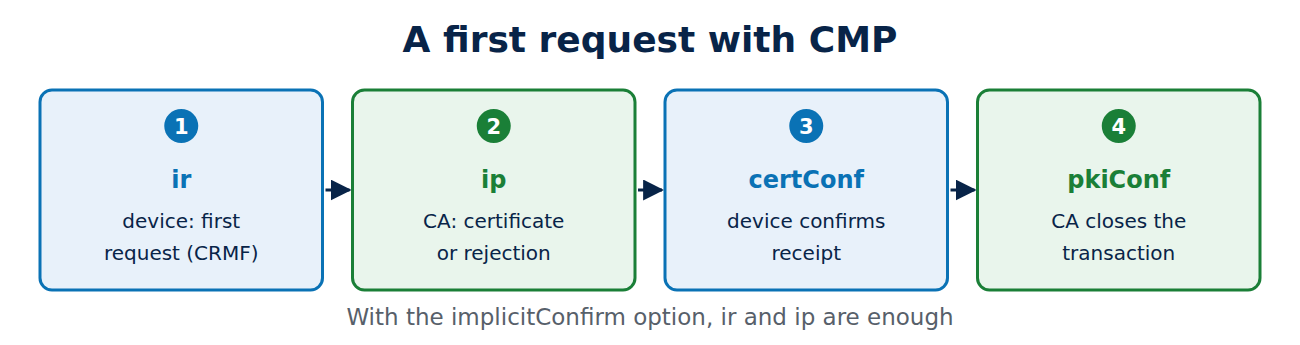
- certConf / pkiConf: the device confirms it has received the certificate. Only then is the transaction complete.
- genm / genp: general queries, for example for new CA certificates.
- pollReq / pollRep: follow-up questions while the CA has not yet decided.
An initial request is therefore four messages: ir, ip, certConf, pkiConf. With the implicitConfirm option, two are enough.
Lightweight CMP: the slim profile
The full specification is so large that different implementations often failed to understand each other. The Lightweight CMP Profile (RFC 9483), published in 2023 and written by specialists at Siemens, therefore sets out which parts are mandatory and which can be dropped. It targets automated processes and devices with little computing power, for example in industrial automation. For transport, RFC 9811 describes sending CMP over HTTP (one message in the body of a POST) and RFC 9482 over CoAP for very small devices.
New in the current version: CMP can manage certificates for KEM keys, keys that are only used to agree on secrets and cannot sign. That matters mainly for the post-quantum algorithm ML-KEM; see what are post-quantum certificates.
Trying CMP with OpenSSL
Since version 3.0, OpenSSL includes a CMP client. An initial request with a one-time password looks like this (server, names and password are examples):
openssl genpkey -algorithm EC -pkeyopt ec_paramgen_curve:P-256 -out device.key
openssl cmp -cmd ir -server pki.example.co.uk:8080/pkix/ -ref device17 -secret pass:OneTimePassword -newkey device.key -subject "/CN=device17" -trusted ca.pem -certout device.pem
For a later key change, the device signs in with its old certificate:
openssl cmp -cmd kur -server pki.example.co.uk:8080/pkix/ -cert device.pem -key device.key -newkey device-new.key -trusted ca.pem -certout device-new.pemThe MAC method with a shared secret is only for first contact. After that, the device signs its messages with its own key, much as in mutual TLS; see what is mutual TLS.
Where CMP is used
- Mobile networks: the 3GPP specification TS 33.310 uses CMPv2 so that base stations obtain their operator certificates automatically.
- Industry and energy: controllers, field devices and EV chargers use CMP or Lightweight CMP, often with a manufacturer certificate as their first credential.
- PKI products: EJBCA, Nexus, Insta Certifier and others offer CMP endpoints, and registration authorities pass requests across several network zones.
For web servers CMP is too heavyweight; ACME remains the standard there. For laptops and smartphones, SCEP or EST is usually enough.
Frequently asked questions
Is CMP the same as CMC?
No. CMC (Certificate Management over CMS, RFC 5272) is a different protocol with a similar aim. EST can carry CMC messages, but is mostly used without them.
Does CMP need HTTPS?
Not necessarily, because every message is protected. HTTPS can add confidentiality, for example so that device names cannot be read in transit.
What does CMPv3 mean?
It is the name of the revised version from RFC 9480 and RFC 9810. It stays largely compatible with CMPv2 and adds KEM keys and new queries, among other things.
Can a device revoke its own certificate with CMP?
Yes, with a revocation request. The CA then adds it to the revocation list; see how certificate revocation works.
Conclusion
CMP is the most complete certificate protocol: initial requests, key updates, revocation and queries in one standard, with message-level protection and forwarding through registration authorities. Lightweight CMP makes it manageable for industry and IoT, and OpenSSL ships a client. More guides in the hub Certificates, PKI and encryption.
Sources and further reading
- RFC 9810: Certificate Management Protocol (CMP) (IETF)
- RFC 9483: Lightweight Certificate Management Protocol (CMP) Profile (IETF)
- RFC 9811: HTTP Transfer for the Certificate Management Protocol (IETF)
- openssl-cmp (OpenSSL documentation)
















Recent Comments